
In 1822 Larkin Mead of Chesterfield wrote a brief historical sketch which was reprinted in a 1924 newspaper article. On this page we have a transcription of that 1924 article (transcribed by Audrey Ericson). We don’t now (2011) know of a copy of the original 1822 article. Oran Randall must have had a copy when he cited it in his 1882 history. The actual 1822 article begins three paragraphs below.

=============The 1924 Newspaper Article ===================
MEAD’S MEMORIES OF CHESTERFIELD
Sculptor’s Father Wrote Sketch of Town Century Ago
LEVI MEAD REBEL AT LEXINGTON ‘75
The dedication of the soldier’s monument at Chesterfield, N. H. in the summer of 1924 awakened a new interest in the town’s history and first brought to the knowledge of many that a historical sketch of the town had been published more than a century ago. This was written by Larkin G. Mead, afterward prominent in the life of Brattleboro, and published in Farmer and Moore’s Historical Collections, at Concord, N. H. in 1822. This work has long since been out of print; and a reprint of the brief Chesterfield sketch should at this time be of interest. The author must have known personally many of the first generation of the town’s inhabitant and his sketch is a valuable chapter in the annals of an old valley town.
Larkin G. Mead was 27 years old when he wrote this little sketch of Chesterfield in 1822. His father, Capt. Levi Mead, came to Chesterfield in 1801 from Lexington, Mass., where as a boy he had carried a powder-horn on the fateful 19th of April, 1775, afterward enlisting for the war. He built the tavern in the village at Chesterfield, which, — kept by his two sons, Bradley and Elias, after him—, was locally famous as “The Old Mead Tavern” for half a century. Edwin D. Mead, who gave the address at the dedication of the Chesterfield monument last summer, is a son of Bradley Mead.
Larkin G. Mead was educated at Chesterfield Academy and Dartmouth College and became a prominent member of the Cheshire bar. He was a man of rare public spirit, active in the cause of education and universally respected both in Chesterfield and in Brattleboro, where he spent the last half of his life. Four of his nine children were born in Chesterfield. Larkin G. Mead, Jr. was the eminent sculptor, Charles Mead was the president of the Stanley Rule and Level Company of New York, Eleanor Mead was the wife of William D. Howells, well-known architectural firm of McKim, Mead & White in New York.
Larkin G. Mead’s historical sketch , from Farmer and Moore’s Historical Collections, follows:
‘========================Below: the 1822 Article ==============================================’
Chesterfield, a post town, in Cheshire County, in latitude 42 degrees, 52 minutes north, is bounded north by Westmoreland, east by Keene and Swanzey, and west by Dummerston, Vt. It contains 29,437 square acres. It is 11 miles from Keene, 65 miles Concord, and 90 miles from Boston. This town is generally hilly and uneven. Few towns on the Connecticut River have so little interval land. For the whole six miles that it lies upon the river, the hills approach near to the river’s side. There is much good upland, and our farmers raise very good crops of hay and Indian corn. The chief articles of export are beef, pork, butter, and cheese.
Chesterfield has three villages. The principal one, through which the stage road passes, leading from Hartford to Hanover, is situated near the center of town and three miles east of the Connecticut River. Here are the meeting house, academy and a number of dwelling houses. The western village is situated near the river, on a considerable stream called “Cat’s-bane Brook” To this stream the village owes its existence; there being no stream of water near the principal village, which is situated on high ground.
Rivers, etc.—The Connecticut river passes through the western bounds of Chesterfield. Cat’s-bane brook is a stream of great importance to the town, furnishing many mill seats. There is something so singular in the origin of its name, that I shall here relate the circumstances which gave rise to it. In “olden time,” when travelers went by marked trees from town to town, two men passed through Chesterfield. They came, on their way, to this brook. They refreshed themselves by eating a luncheon and drinking of the waters. One of our travelers was in a hurry, while the other was disposed to linger. As the first urged his companion to quit the brook and travel on, the other told him very coolly he was in no haste, and wished to drink again from the brook, and bending leisurely down, took another draught, at which his impatient and enraged companion exclaimed, “D—n you, I wish the brook was Cat’s-bane, for your sake,” meaning probably Rat’s-bane. The expression produced no small merriment among those to whom it was related and the brook has been ever since called “Cat’s-bane brook.”
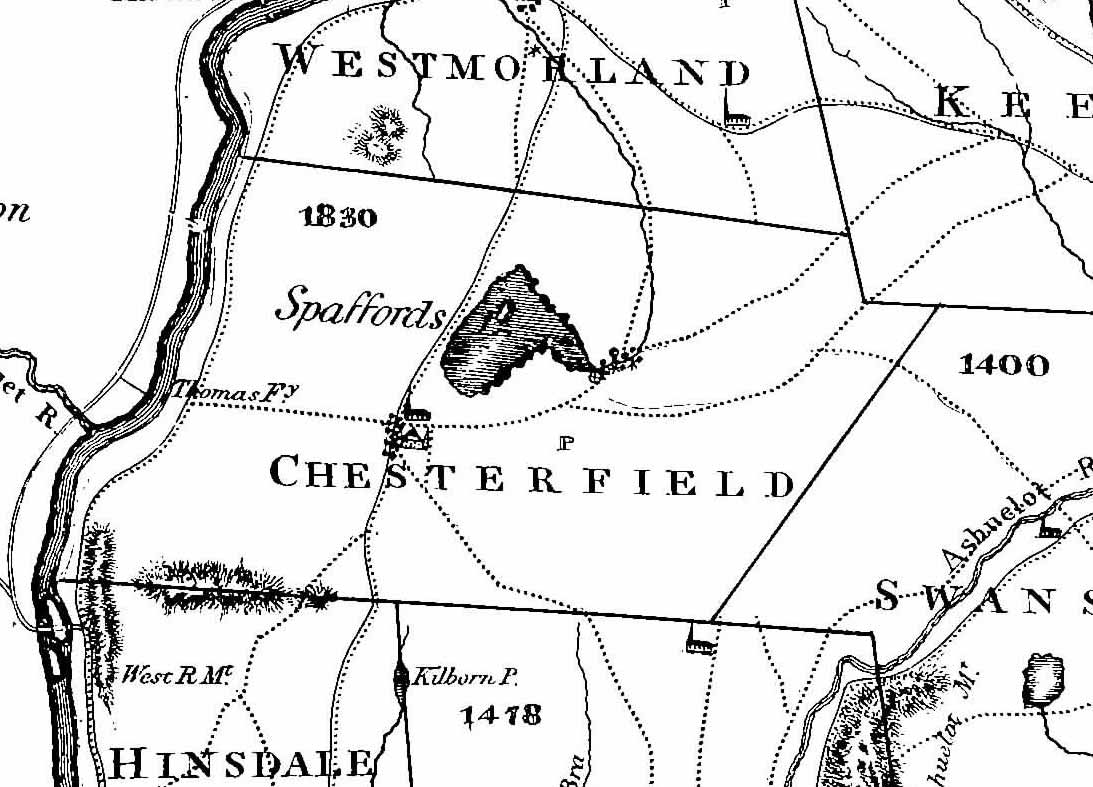 Spafford’s lake is situated about one mile north of Chesterfield meetinghouse. This beautiful lake is of great importance to the town. It is about eight miles in circumference, fed by springs in its bosom. No considerable stream empties into it, but one issues from it sufficiently large to carry the machinery of a cotton factory, sawmills, grist-mills, etc.
On this stream, issuing from the east side of the lake is situated the east village of Chesterfield. This stream, which is called “Patridge’s brook, after running about six miles and furnishing many fine mill seats, empties into the Connecticut river near Westmoreland village. The water of this lake is remarkably clear and pure—its bed being a white sand, used for sanding floors. You may see small fish in its waters at the depth of 20 feet. Although it contains pickerel, perch, and other kinds of fish, they are not sufficiently plenty to make what would be called good fishing. In this lake is a very pleasing island, containing about eight acres.
Many of our good people will have it that this island was the former residence of a tribe of Indians; and show walls built out to considerable distance and at no small labor, forming a sort of cove, in which these same Indians used to take fish. They also show a hollow rock, in which they mashed their corn—a level plat of ground on which they performed their several dances, and a mound under which they buried their chief. On the death of their chief (as the story goes) they left this island and moved westward. With regard to the truth of the tradition, I can only say I have viewed the places mentioned and see no reason why this story may not be true. The lake took its name from a man by the name of Spafford who, before any considerable settlement was made in town, purchased a lot on its shore, and made the first cleaning near it. He being the only man who lived near it, it soon acquired the name of “Spafford’s lake.”
Mountains—The most noted mountain in Chesterfield is West River mountain lying partly in Chesterfield and partly in Hinsdale. There was once a volcanic eruption from this mountain. There is at present a considerable quantity of lava near its crater. The town of Chesterfield, and the towns about it, were formerly granted by Massachusetts. At that time Chesterfield was called No. 1; Westmoreland, No. 2; Walpole, No. 3; and Charlestown, No. 4. In township No. 1 Gov. Belcher reserved to himself a part of the territory of the town; the aforesaid mountain was assigned to him and was known by the name of the “governor’s farm”.
The early inhabitants of the vicinity discovered uncommon appearances about the mouth of this volcano, and seeing an aperture in the mountain, supposed it led to a silver mine which had blown out, as they expressed it. Several associated with a view to make their fortunes by digging in the mountain. Their first step was to consult a famous fortune-teller, who confirmed them in their suspicions. He assured them of finding silver in great abundance. But they did not own the land. They therefore dispatched one of their company to the then proprietors of whom they obtained a lease of that part of the mountain which contained the supposed mine. One condition of the lease was, that they should dig, during the term for which they held the lease, at least three days in each year, or the lease should become void. At this time, they have dug principally through a rock, between 90 and 100 feet, following the course of the crater downward. Although they have never found anything of value, except a few hogsheads of red and yellow ochre, they are unwilling to give up, and to this time regularly dig at least three days in each year in the mountain, that they may not forfeit their lease. ‘Tis said by those who live near the mountain, that it frequently trembles and a rumbling noise is heard in its bowels. It takes its name from West river, which empties into the Connecticut exactly opposite this mountain.
Pistareen mountain, situated on the eastern shore of Spafford’s lake, is next in importance.
It is formed like a sugar loaf, and is almost inaccessible—large rocks projecting from its sides. It is called Pistareen mountain from having once been sold for a pistareen, or 20 cents. To see it, one would think that a fair price.
There is a cave, in the northwestern part of Chesterfield, near the side of a small stream called Governor’s brook. It is sufficiently curious to reward one for the trouble of going to see it, if he were passing near it.
History—The town of Chesterfield was granted Feb. 11, 1752. It was divided into 70 equal shares and granted to 65 “loving” subjects, inhabitants of the Province of New Hampshire, and his Majesty’s other governments.” Sixty-five shares were divided among 65 grantees, and the remaining five shares were granted as follows: “:One tract of land to contain 500 acres, which is to be accounted two shares, to His Excellency Benning Wentworth, Esq.; one whole share for the incorporated society for the Propogation of the gospel in foreign parts; one whole share for the first settled minister of the gospel in said town; and one whole share for a glebe for the ministry of the Church of England, as by law established.” It is described in the charter “a tract of land containing six miles square.”
On the 25th of November, 1761, Moses Smith and William Thomas, with their families, came to Chesterfield and began a settlement on the bank of the Connecticut river. Their descendants now occupy the land they first began upon. At that day the river afforded them an abundance of shad and salmon, and the surrounding woods were well stocked with deer, bears, and wild turkeys; so that they soon made out to live comfortably, experiencing no particular hardships, other than such as are incidental to all new settlements. In consequence of dams across the river below us, shad and salmon cannot ascend so high as Chesterfield. In the spring of 1762, Abel Emmons and Capt. Simon Davis moved into Chesterfield. From that time the population so increased that in less than 10 years the town contained 150 families. Its present population is 2110.
Churches–The Congregational church was formed in Chesterfield in 1771—consisting of 20 male members and about as many females. Since its organization, 131 males and 188 females (in all 319) have been admitted members of the church; now living in town 108. Rev. Abraham Wood was ordained over this church and people, Dec.31, 1772, the 25th year of his age. Mr. Wood is a graduate of Harvard college, has preached in Chesterfield every year since he was ordained; and at this time, although 73 years old, enjoys almost perfect health and preaches every Sabbath. There is a small society of Baptists in town. They have no meeting house and no settled minister or regular preaching. They were incorporated under the name of First Baptist society in Chesterfield, June 21, 1819. There is also a small society of Universalists, incorporated June 22, 1818, by the name of the Chesterfield Universal Restoration society. This society has no meeting house, minister or regular preaching. There are a few Methodists and two families of Friends or Quakers.
Schools, etc.—Chesterfield academy was incorporated in January, 1790, and was opened Aug.14, 1794. It has no funds, but the school has continued every year since it commenced under the direction of a preceptor and 11 trustees. This was until within three years the only academy in Cheshire county; and this school, under the instruction of a succession of able preceptors, has acquired considerable reputation. Otis Hutchins is the present preceptor, a man eminently qualified for the employment. There are 14 school districts in Chesterfield, the school supported by taxes as in other parts of the state. Upon an average, the schools continue three months in the winter and three months in the summer.
The Philesian society is a literary society composed of students at the academy, for the time being, and other literary young gentlemen in the vicinity. It was instituted A. D. 1808, upon the plan of the society of the Social Friends of Dartmouth college. Every student “of good moral character, and who is desirous to encourage and promote literature,” may become a member and enjoy the advantages of this society. The society has already a library of valuable books, which is yearly increasing.
We have a “social library” incorporated June 9, 1803, with about 50 proprietors.
The first white child born in Chesterfield was Mary Thomas, born 1762. She married Lemuel Stoddard and now resides in town. Mrs. ____ Cephas now lives in town, aged 105.
The first sawmill was built in 1762 by Ensign Moses Smith and John Snow, the proprietors granting to them two pieces of land in said township on condition “that they would build such a mill, keep it in good repair for five years next coming, and saw boards at as reasonable a rate as other men do in the neighboring towns.”
Hon. Levi Jackson, late a senator and counselor in this state, was a native of Chesterfield, born June 20, 1772. He died Aug. 30, 1821. Mr. J. graduated at Dartmouth college and was for six years preceptor of the academy in this place.
Rev. Roswell Shurtleff, at present a professor at Dartmouth college, is a native of Chesterfield. He was the early associate and classmate of Mr. Jackson.
The Preceptors of Chesterfield academy have been: 1794, Sheldon Logan, one year; 1795, John Noyes, three years; 1798, Broughton White, one year; 1799, Levi Jackson, six years; 1805, Daniel Hardy, two years; 1808, Samuel Fletcher, one year; 1809, Jonathan Hartwell, one year; 1810, Asa Keyes, two years; 1812, Isaac McConihe, one year; 1813 Otis Hutchins, two years; 1815, Elisha Plumb, two years; 1817, Thomas Hardy, three years; 1820, Otis Hutchins, two years.